Amazonia City Lab Initiative
The Urban Amazon?
Contrary to popular belief, the Amazon rainforest is an urbanised region. This may sound counterintuitive, but over 70% of the Amazon’s population lives in towns and cities. In Brazil, this share has been above 50% since the 1980s. Small and medium-sized towns in particular are growing fast1.
Most of these towns face gaps in basic services. Over 60% of urban populations in the region live in vulnerable conditions. Access to clean water, sanitation, electricity and waste management is often precarious. As a WEF publication puts it: There is no rescuing the rainforest without tending to the towns where most Amazonians live. Functional urban infrastructure is not a luxury that comes after conservation. It is a precondition for it. People who lack basic living conditions cannot be expected to sustain a “standing-forest flowing-rivers bioeconomy”.1
This was the starting point for our considerations and the Amazonia City Lab Initiative.
The Initiative: Bringing Morgenstadt to the Amazon
The Morgenstadt Initiative at Fraunhofer has worked with over 100 partner cities across four continents. Its City Lab methodology tries to combine systems analysis with co-creation: Researchers and local stakeholders jointly diagnose the status quo, develop strategic roadmaps and identify priority projects.2
In 2024, a consortium of Fraunhofer IAO, Amazonia 4.0 / AmIT and Fundação Getulio Vargas (FGV) began to explore whether this methodology could be adapted with and for small towns in the Brazilian Amazon. The premise was simple: These towns often have strong local motivation and active grassroots initiatives, but are in need of the technical capacity and institutional bridges to act on them. External funding often gets “stuck” at higher levels of governance and administration. The question was whether a co-creative research partnership could help close that gap, without imposing solutions from outside.
This vision was shaped through a series of exchanges with Carlos Nobre, the driving force behind Amazonia 4.0, Adalberto Val, Vice President of the Brazilian Academy of Sciences for the Northern Region, Maritta Koch-Weser, program leader at the University of São Paulo’s Institute for Advanced Studies and André Luis Willerding of Amazonia 4.0. We were strongly supported by Manuel Steidle, Head of the the Fraunhofer Liaison Office Brazil and both by Prof. Dr. Vanessa Borkmann and Prof. Dr. Katharina Hölzle of the Fraunhofer IAO directorate.
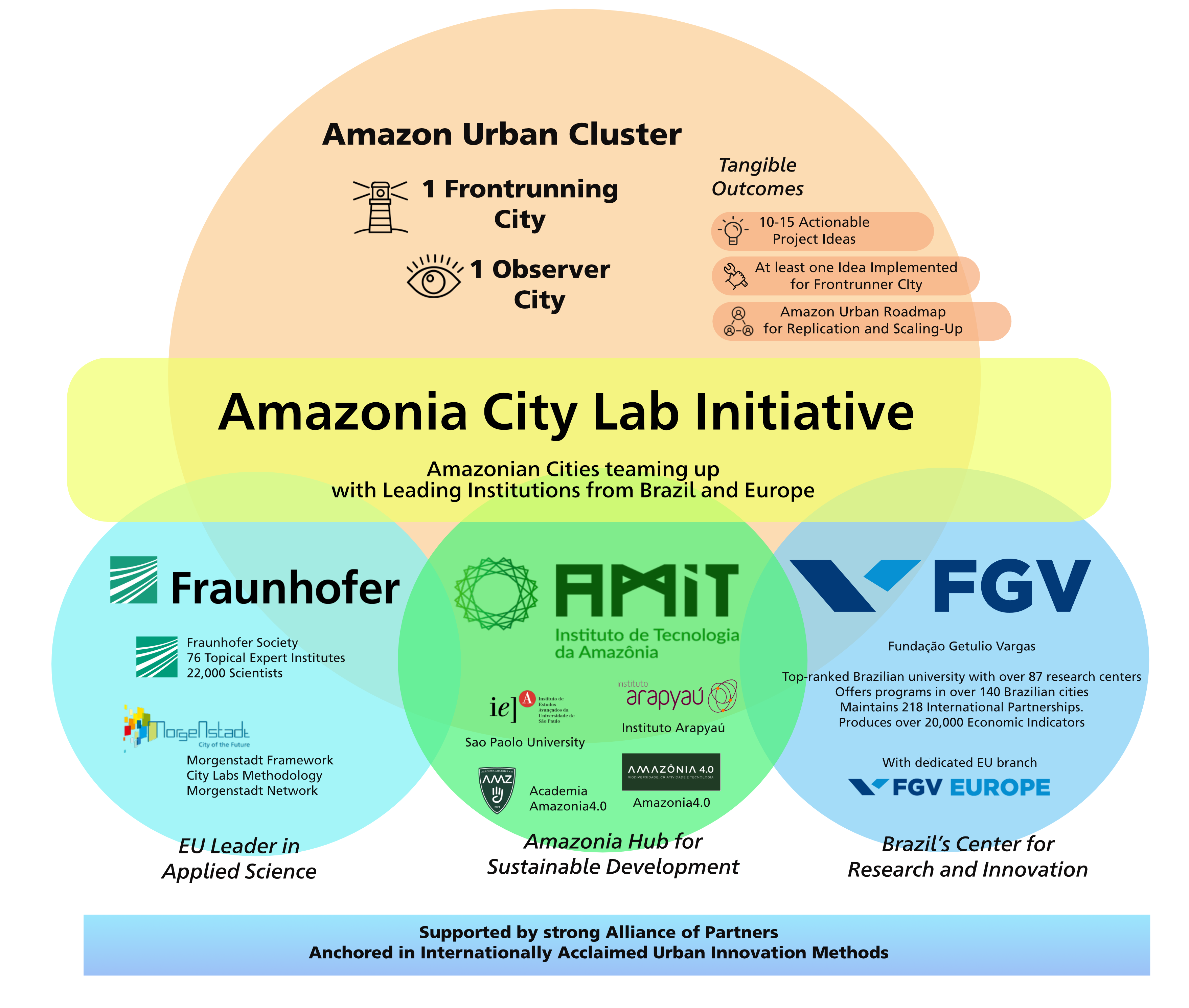 Amazonia City Lab Initiative: Amazonian cities teaming up with leading institutions from Brazil and Europe.
A Partnership with Novo Airão
Over 2024 and 2025, we narrowed the broad framing towards a concrete pilot. While the consortium developed the overall vision, Amazonia 4.0 strengthened its ties to the municipality of Novo Airão, which became the focal point for a possible collaboration due to existing local momentum and local readiness.
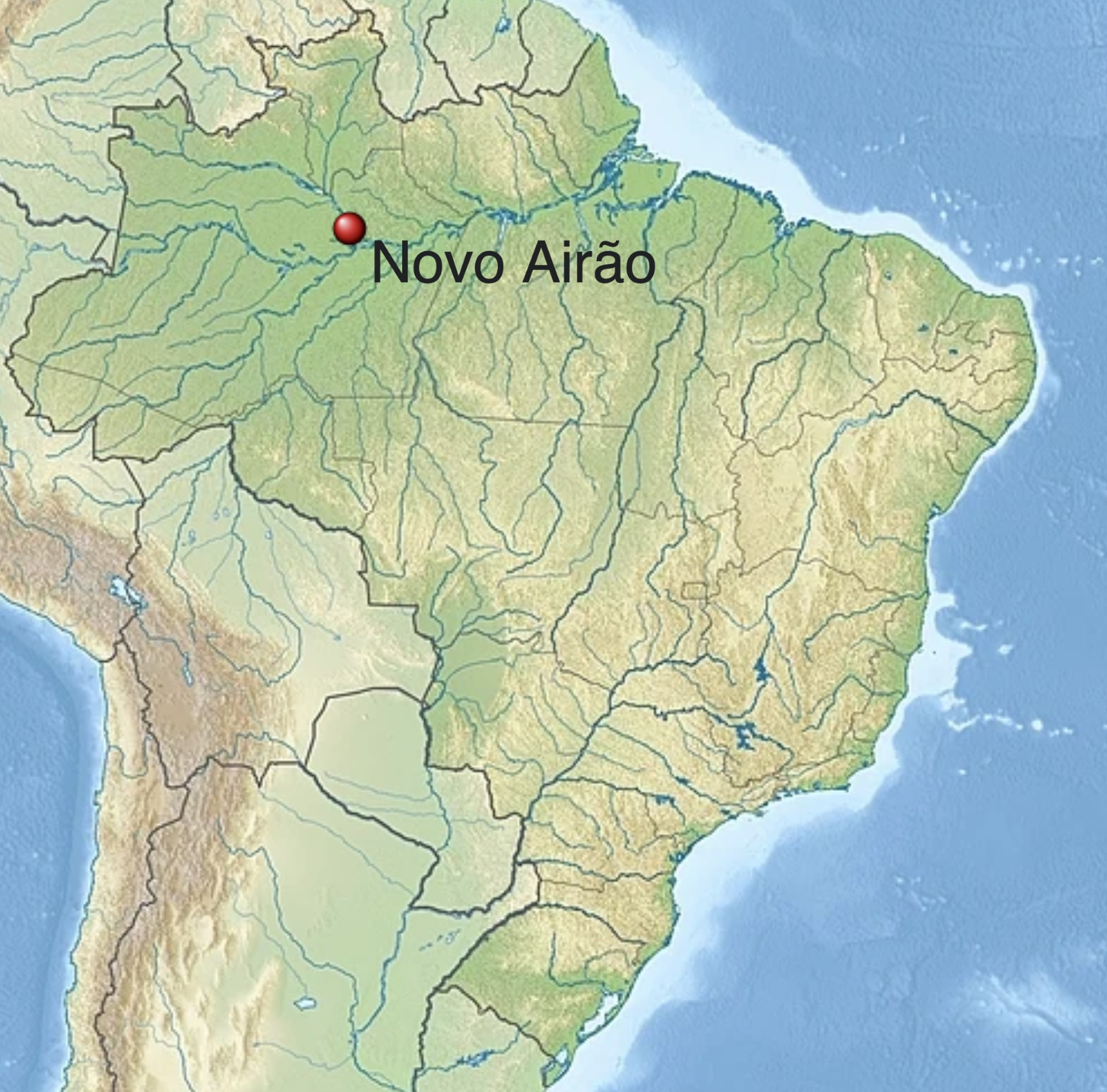 Map of Brazil with Location of Novo Airão Source: Wikimedia Commons

Novo Airão is situated on the Rio Negro at the gateway to the Central Amazon Conservation Complex UNESCO World Heritage Site, which includes the Anavilhanas Archipelago, and south of the Jaú National Park. Approximately 15,000 to 20,000 people live there with 12 indigenous and traditional riverine communities in its direct vicinity. The town has a growing ecotourism sector, a formalised Innovation Secretary within the municipal government and strong ties to regional actors including Amazonia 4.0. Local eco-hotels already practise waste separation, and a recyclable-pickers cooperative, COOPCAMARE, has established and rooted itself in the collection and recovery of recyclable waste.
What the local actors identified as their most pressing gap was processing capacity. When too much plastic accumulates and cannot be processed on site, it gets trucked back to the general dump, which in practice often means open burning and leakage into the waterways.
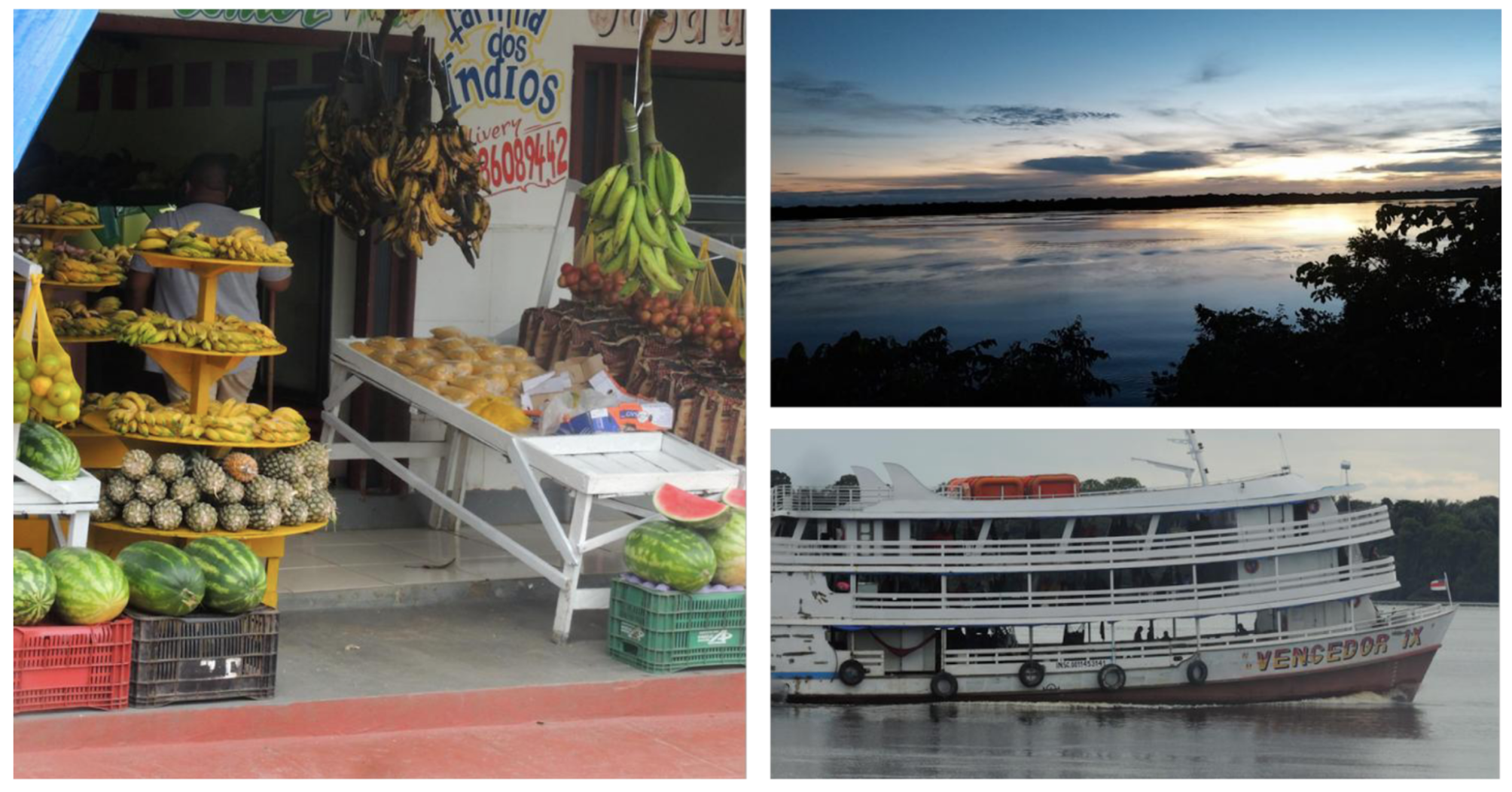 Novo Airão, Amazonas. Photos: André Willerding, Amazonia 4.0.
The Proposal: A Community-Owned Eco-Factory
When the International Climate Initiative (IKI) opened its Medium Grants call in late 2025, we saw an opportunity to translate this locally identified gap into a concrete project proposal. Together, we designed a concept for a community-owned, open-source plastics recycling and upcycling Eco-Factory: A small-scale facility where commonly recoverable household plastics are sorted, cleaned, shredded and converted into usable materials and products, from pressed sheets and panels to 3D-printed utility items for local services, tourism and education.
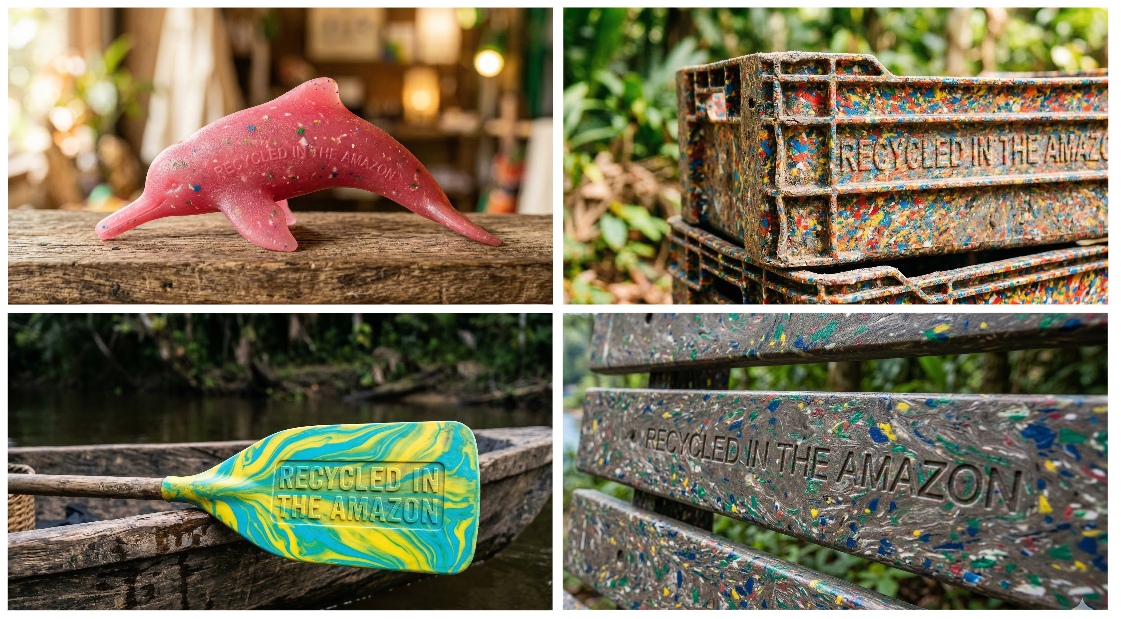 What the envisioned Eco-Factory could produce: From tourist souvenirs to crates, canoe paddles and park furniture, all made from locally recycled plastic.
The design choices tries to reflect the principle of local ownership. The envisioned facility is built entirely around open-source hardware and documented standard operating procedures, so that it can be maintained, adapted and eventually replicated with local skills. The project explicitly aims not to begin with installing equipment but with community mapping, governance setup and co-creating possible operating rules. A local steering committee including COOPCAMARE, Amazonia 4.0, municipal representatives, and women’s and youth representatives shall approve product priorities, benefit-sharing and monitoring. Where riverine and traditional communities are involved, participation must follow informed opt-in formats.
The consortium’s roles also try to reflect the equal-footing structure. Fraunhofer IAO leads overall coordination, administration and technical quality assurance for any material that come outside the project region. FGV supports governance design, business model feasibility and policy interface. Amazonia 4.0 leads on local engagement, inclusion measures and on-the-ground operational support. The Municipality of Novo Airão acts as local host providing coordination and enabling conditions.
Sounds and reads feasible - yet, it’s only a grant proposal so far. See also visual abstract below.
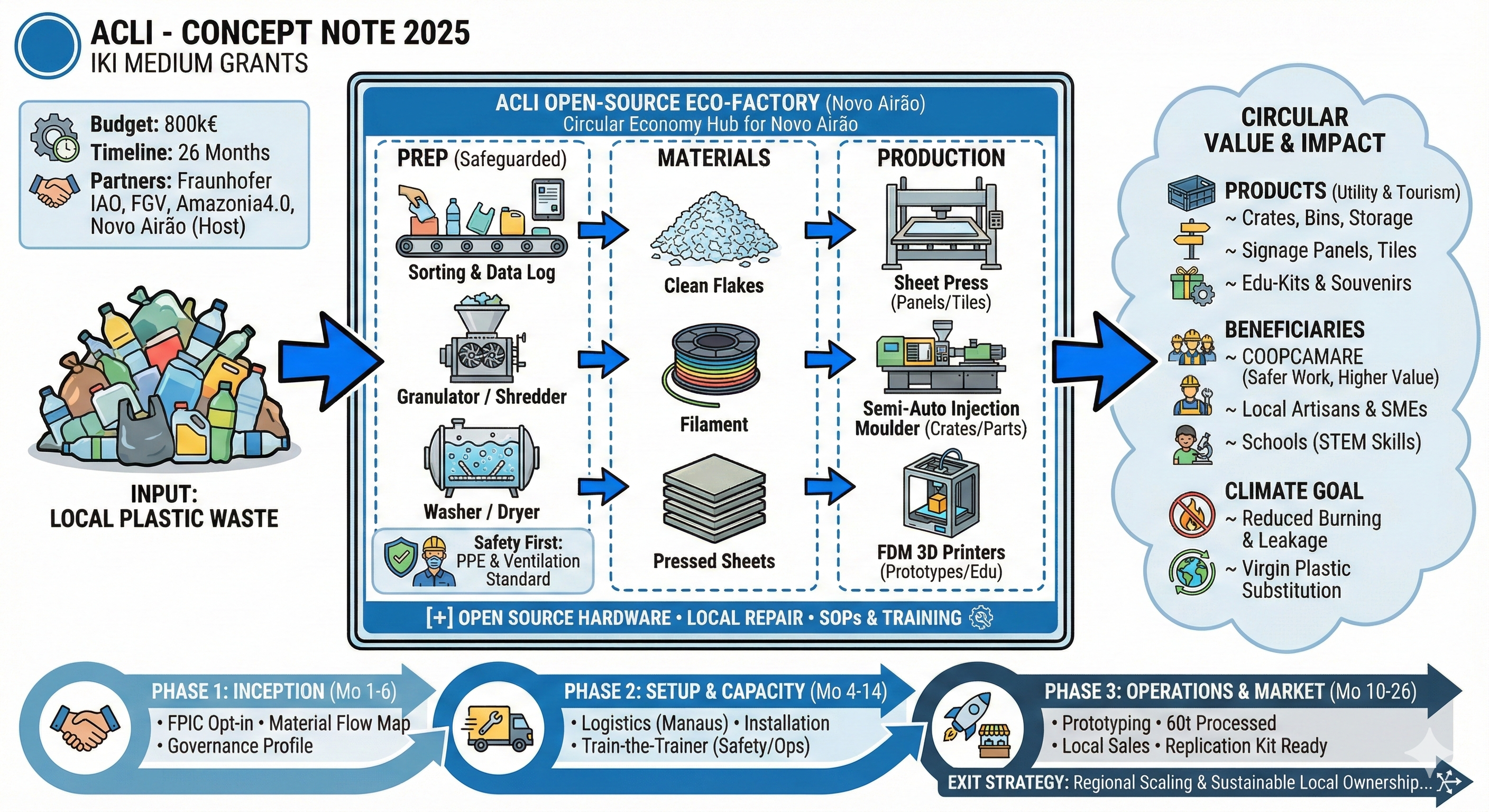 Visual abstract of our IKI proposal (gemini)
Current Status
In January 2026, we submitted our ACLI concept note to IKI - and have had our fingers crossed ever since. With 296 project outlines submitted in this round, competition is fierce and funding is anything but certain. We continue to explore additional funding vehicles alongside our local partners.
The underlying question guiding our work remains: How can applied research institutions contribute meaningfully to places where sustainability challenges are most pressing, without replicating patterns of one-directional knowledge transfer?
Regardless of the outcome, working on this initiative and jointly writing and rewriting our outline, travelling to Brazil and meeting the people involved, has been one of the most personally rewarding things I’ve done during my time at Fraunhofer IAO.
Partners
- Consortium Lead: Fraunhofer IAO
- Implementing Partner: Fundação Getulio Vargas, FGV
- Implementing Partner: Amazonia 4.0 / AmIT
- Host: Municipality of Novo Airão
Related
- The beginning and early grand-vision of the Amazonia City Lab Initiative: Outline and Cover Letter (PDF)
- Website Morgenstadt Initiative
- Website International Climate Initiative, IKI
- Website Amazonia 4.0
- Link: UNESCO: Central Amazon Conservation Complex
- Link: IDB: Amazonian Cities Forum
- Link: “WEF: How Amazonia cities can help build a sustainable planet”
- Link “Pulitzer Center: The Amazon Rainforest Is Urban, Too”
Footnotes
-
See: IDB Amazonian Cities Forum; Pulitzer Center: “The Amazon Rainforest Is Urban, Too”; Durán Calisto, da Costa, et al. Sustainable Cities in the Amazon. Policy Brief. Science Panel for the Amazon, Sustainable Development Solutions Network, New York, USA (2025). DOI: 10.55161/ACNT1416; World Economic Forum (2025) Securing “Amazonia cities for a resilient and sustainable planet”. ↩ ↩2
-
Having worked with the methodology, I think the method has shown to be successful in the past because it tries to create an equal footing between external expertise and local knowledge. To me personally, I like a lot how the City Labs try valuing both the qualitative (e.g. governance factors) and quantitative dimensions (e.g. infrastructure data) of urbanity at the same time. ↩
